It's been a long time since I've posted. (Actually, it's been a long time since anyone has posted, hasn't it?) But Bethany prodded me on Facebook recently, wondering where I've been hiding.
This will bring you up to speed: http://ktliterary.com/2010/03/guest-blog-by-trish-doller-take-two/
I'll wait here. Then maybe we can talk about those speed bumps we encounter on our way to publication, k?
Monday, May 3, 2010


Thursday, December 31, 2009
New Year, New Goals
My academic pursuits have become a sorry excuse for me to avoid my writing. Gone are the days of finishing up a chapter before midnight--I'm cramming for physics class instead. I can no longer doodle character sketches in my English notebook--I need to ace my state exams.
Over 2009, my writing slid to the back burner as I took a hiatus from traditional high school and volunteered abroad. Was it worth it? Of course. I sacrificed a social life and sophomore year for an incredible opportunity I look back on with longing. But I never anticipated 2009 to lack what I love best about my life: my writing. I lugged my old laptop across continents hoping to find the perfect setting for my next novel. My idea of the perfect getaway, crammed with action and quirky people, left me exhausted and jet-lagged.
I'm determined not to let my writing slip past me again. I'm now employed as a reporter (woohoo!) and I need to take my writing to the next level. I may be concentrating a tad bit less on my novels, but I'm determined to do it all. My family has always joked that I'm a jack-of-all-trades with seven million hobbies, but this year, I'm going to prove it!
My goals for 2010 are simple: conquer my latest novel and polish my clip portfolio. I'm excited and enthusiastic about my job and eager to prove myself. As for my novel, I've waited until I thought I was skilled enough to tackle a new genre and my favorite plot. Can I do it? I'll find out next New Year's Eve.
What are your writing goals for 2010? Ambitious, or are you going to take a year to learn as much about life as you can for novel fodder? Are you going to tackle fiction, non-fiction, or both?
We'll face the new year armed with our goals. 2010 is going to be awesome.
(I hope.)
Over 2009, my writing slid to the back burner as I took a hiatus from traditional high school and volunteered abroad. Was it worth it? Of course. I sacrificed a social life and sophomore year for an incredible opportunity I look back on with longing. But I never anticipated 2009 to lack what I love best about my life: my writing. I lugged my old laptop across continents hoping to find the perfect setting for my next novel. My idea of the perfect getaway, crammed with action and quirky people, left me exhausted and jet-lagged.
I'm determined not to let my writing slip past me again. I'm now employed as a reporter (woohoo!) and I need to take my writing to the next level. I may be concentrating a tad bit less on my novels, but I'm determined to do it all. My family has always joked that I'm a jack-of-all-trades with seven million hobbies, but this year, I'm going to prove it!
My goals for 2010 are simple: conquer my latest novel and polish my clip portfolio. I'm excited and enthusiastic about my job and eager to prove myself. As for my novel, I've waited until I thought I was skilled enough to tackle a new genre and my favorite plot. Can I do it? I'll find out next New Year's Eve.
What are your writing goals for 2010? Ambitious, or are you going to take a year to learn as much about life as you can for novel fodder? Are you going to tackle fiction, non-fiction, or both?
We'll face the new year armed with our goals. 2010 is going to be awesome.
(I hope.)
Wednesday, October 7, 2009
Inbox (1)
Oh, Gmail,
How that little (1) can send my heart into palpitations. How I can't resist the lure of that shiny new e-mail. How much you promise me two days after I status queried about a full. How I anticipate that you may have news on a request, even though the sender's name says "intern," and I know no agent with my manuscript has yet sent me anything through interns. This could be the time. There could be a reason. I click, anxiously, wondering what news you bring. Hoping you are not the dream agent who's had my full novel for three months and would only send through interns if she was form rejecting. I hold my breath....
Hmm, a query rejection from an agency I barely remember querying. Oh, Gmail, how you have fooled me with that precious (1). I shall not be fooled agai--
Oh, my! "Inbox (1)." My heart skips a beat.
How that little (1) can send my heart into palpitations. How I can't resist the lure of that shiny new e-mail. How much you promise me two days after I status queried about a full. How I anticipate that you may have news on a request, even though the sender's name says "intern," and I know no agent with my manuscript has yet sent me anything through interns. This could be the time. There could be a reason. I click, anxiously, wondering what news you bring. Hoping you are not the dream agent who's had my full novel for three months and would only send through interns if she was form rejecting. I hold my breath....
Hmm, a query rejection from an agency I barely remember querying. Oh, Gmail, how you have fooled me with that precious (1). I shall not be fooled agai--
Oh, my! "Inbox (1)." My heart skips a beat.
Sunday, September 27, 2009
Edgy YA again!!!
Okay, so next weekend I'm presenting at the KY librarian's conference, and my subject is getting kids to read with edgy YA. I'll be presenting with something similar in November at the SCBWI midsouth Schmooze in Louisville.
If anyone would like to be quoted in my presentation, please tell me either (or both)
your definition of edgy/edgy in YA, an example of YA you think is edgy, and or what you think is appealing about this type of literature to some (particularly reluctant) readers.
Thanks so much! I plan to post the presentation on my blog, as well.
If anyone would like to be quoted in my presentation, please tell me either (or both)
your definition of edgy/edgy in YA, an example of YA you think is edgy, and or what you think is appealing about this type of literature to some (particularly reluctant) readers.
Thanks so much! I plan to post the presentation on my blog, as well.
Tuesday, September 1, 2009
SCBWI Midsouth Conference Blog
YAYA contributors Amanda K. Morgan and Suzanne Young are live-blogging SCBWI Midsouth in Nashville starting September 25th. Follow their blog for all the juicy gossip. (I mean, that's why I'm following it. You might want industry news or whatever.)
Check it out!
Check it out!
Saturday, August 29, 2009
This shouldn't even be necessary...
...but if I have to read one more thread/post/article/thing wherein the author of said thread/post/article/thing does not know that there is a difference between children's literature, MG and YA, I'm going to go into conniptions. I have to get this off of my chest.
Now, for those of you who do not follow Editorial Anonymous, YOU SHOULD. Her blog is geared towards those of us writing in the children's/MG/YA genres and contains tons of useful information about the genre and distinctions between the different "levels" of writing for those of us under the age of 18. In her words:
That is, I think, a great way to identify your audience (ie: girls ages 11-13, or boys ages 15-17). However, since you need to correspond to the industry conventions when you're querying, I'm going to try to break this down in nifty list format, as is my way.
DISCLAIMER: The ages used as examples in these definitions should be treated as such. Also, unfortunately there is a lot of bleed over between children's literature and MG, and between MG and YA. It's confusing as hell and I'm not going to spend a boatload of time going through all of the exceptions. These are just rules of thumb.
1. CHILDREN'S LITERATURE: This is a messy term. It can mean, in various contexts, "all writing for those members of the human race who are currently not the age of majority" or "all writing for those members of the human race who are currently not over 10 years of age." This means that the agent who says she reps "children's literature" might represent anything from picture books to YA, and, generally, you can assume that she does unless she specifies otherwise.
I'd like to see "children's literature" correspond directly and without any muzzy edges to the second definition I provided. This means that it would include things like picture books, chapter books, and novels written for kids. (Think the books that are available at the Scholastic Book Fairs for elementary school students.) There are things you shouldn't write about in children's literature. Dropping the f-bomb is probably a no-no. So is negative characterization of parents and "trusted adult" types.
Children's literature (of the second type) is not MG. However, some may choose to read MG while they are still considered children's lit readers by the publishing world. This is perfectly fine. You should write your children's books with your intended audience in mind and let the individual reader decide what she wants to read.
2. MG: Stands for "middle grade." Should remind you of the term "middle school." MG is generally considered to be literature for those humans with 11-13 years of life under their belts. MG is not children's lit and it isn't YA lit either, and that seems to cause a lot of confusion. In MG, I would still, personally, be hesitant to tackle some of the issues we have no problem with tackling in YA lit - or, at least, tackling them in the same way. In MG literature, the author should generally have a negative view of "edgy" goings-on. Drugs can be taken, but they lead down a bad road. Flirtation can occur, but there should be no sex. Cursing and swearing is limited to things like "piss-face" and "dang!". If you want a good example of how to incorporate swearing into MG, I would look at the early Harry Potter books. And the later Harry Potter books, for that matter, to see the transition between fakey-swears and full-out-swears.
This seems to be the genre everyone forgets when talking about literature for under-18s. REMEMBER THAT IT EXISTS. Correct people when they tell you that their novel geared towards 12 year-olds is YA. Explain to people the difference when they complain that there is nothing in the YA section for their 13 year-old to read.
MG literature is not YA. However, some may choose to read YA while they are still considered MG readers by the publishing world. This is perfectly fine. You should write your MG books with your intended audience in mind and let the individual reader decide what she wants to read.
3. YA: Stands for "young adult." Emphasis on the "adult." You may write whatever you damn well please in a YA novel as long as you can write about it in a novel written for an adult audience. This means that anything with bestiality (or water sports, or graphic incest...), bloody graphic violence, and overly explicit sex (I will not answer what qualifies as explicit because you are all intelligent people and should know. If you really want a rule of thumb, it should probably not resemble this: "PENIS PENIS PENIS PENIS COCKKKK!!!!!!!!!!!" K?) will be a hard sell. You may use your discretion. Everyone has different opinions on what is appropriate or not in YA fic, but then again everyone has opinions on what is appropriate or not in adult fic as well.
The major distinction between MG and YA comes in two parts: first, the "coming-of-age." I define coming-of-age as having to deal with adult problems with a teenage mind. Remember the scene in Juno when she comes back home after learning that the potential adoptive father of her unborn child has decided to get a divorce? Her father asks her what she's been up to, and Juno responds: "Oh, nothing. I've just been out dealing with things way beyond my maturity level." Bam. Coming-of-age. Second, the edgy stuff I talked about previously is no longer dealt with in black and white terms. Now the characters are exposed to drugs, sex, and rock 'n' roll, and they decide for themselves how they feel about them.
So there it is folks. Rant over. Hope this cleared things up for some of you.
Now, for those of you who do not follow Editorial Anonymous, YOU SHOULD. Her blog is geared towards those of us writing in the children's/MG/YA genres and contains tons of useful information about the genre and distinctions between the different "levels" of writing for those of us under the age of 18. In her words:
I'm a bit of a curmudgeon when it comes to these designations. I just don't care what "chapter book," "middle grade," or "YA" are currently supposed to mean. Why don't we simply speak in terms of ages, or grades?
That is, I think, a great way to identify your audience (ie: girls ages 11-13, or boys ages 15-17). However, since you need to correspond to the industry conventions when you're querying, I'm going to try to break this down in nifty list format, as is my way.
DISCLAIMER: The ages used as examples in these definitions should be treated as such. Also, unfortunately there is a lot of bleed over between children's literature and MG, and between MG and YA. It's confusing as hell and I'm not going to spend a boatload of time going through all of the exceptions. These are just rules of thumb.
1. CHILDREN'S LITERATURE: This is a messy term. It can mean, in various contexts, "all writing for those members of the human race who are currently not the age of majority" or "all writing for those members of the human race who are currently not over 10 years of age." This means that the agent who says she reps "children's literature" might represent anything from picture books to YA, and, generally, you can assume that she does unless she specifies otherwise.
I'd like to see "children's literature" correspond directly and without any muzzy edges to the second definition I provided. This means that it would include things like picture books, chapter books, and novels written for kids. (Think the books that are available at the Scholastic Book Fairs for elementary school students.) There are things you shouldn't write about in children's literature. Dropping the f-bomb is probably a no-no. So is negative characterization of parents and "trusted adult" types.
Children's literature (of the second type) is not MG. However, some may choose to read MG while they are still considered children's lit readers by the publishing world. This is perfectly fine. You should write your children's books with your intended audience in mind and let the individual reader decide what she wants to read.
2. MG: Stands for "middle grade." Should remind you of the term "middle school." MG is generally considered to be literature for those humans with 11-13 years of life under their belts. MG is not children's lit and it isn't YA lit either, and that seems to cause a lot of confusion. In MG, I would still, personally, be hesitant to tackle some of the issues we have no problem with tackling in YA lit - or, at least, tackling them in the same way. In MG literature, the author should generally have a negative view of "edgy" goings-on. Drugs can be taken, but they lead down a bad road. Flirtation can occur, but there should be no sex. Cursing and swearing is limited to things like "piss-face" and "dang!". If you want a good example of how to incorporate swearing into MG, I would look at the early Harry Potter books. And the later Harry Potter books, for that matter, to see the transition between fakey-swears and full-out-swears.
This seems to be the genre everyone forgets when talking about literature for under-18s. REMEMBER THAT IT EXISTS. Correct people when they tell you that their novel geared towards 12 year-olds is YA. Explain to people the difference when they complain that there is nothing in the YA section for their 13 year-old to read.
MG literature is not YA. However, some may choose to read YA while they are still considered MG readers by the publishing world. This is perfectly fine. You should write your MG books with your intended audience in mind and let the individual reader decide what she wants to read.
3. YA: Stands for "young adult." Emphasis on the "adult." You may write whatever you damn well please in a YA novel as long as you can write about it in a novel written for an adult audience. This means that anything with bestiality (or water sports, or graphic incest...), bloody graphic violence, and overly explicit sex (I will not answer what qualifies as explicit because you are all intelligent people and should know. If you really want a rule of thumb, it should probably not resemble this: "PENIS PENIS PENIS PENIS COCKKKK!!!!!!!!!!!" K?) will be a hard sell. You may use your discretion. Everyone has different opinions on what is appropriate or not in YA fic, but then again everyone has opinions on what is appropriate or not in adult fic as well.
The major distinction between MG and YA comes in two parts: first, the "coming-of-age." I define coming-of-age as having to deal with adult problems with a teenage mind. Remember the scene in Juno when she comes back home after learning that the potential adoptive father of her unborn child has decided to get a divorce? Her father asks her what she's been up to, and Juno responds: "Oh, nothing. I've just been out dealing with things way beyond my maturity level." Bam. Coming-of-age. Second, the edgy stuff I talked about previously is no longer dealt with in black and white terms. Now the characters are exposed to drugs, sex, and rock 'n' roll, and they decide for themselves how they feel about them.
So there it is folks. Rant over. Hope this cleared things up for some of you.
Friday, August 28, 2009
Six (Super Short) Reviews
Hello Readers!
Today I have a new kind of post for you. Instead of taking the time to write a lengthy review for each of the books I've read this week, I'm simply going to give you a very straightforward paragraph laying out my thoughts and feelings on the books. You will be missing out on plot, extensive information about the characters (including names), and some other information I tend to inject into my reviews, but these reviews are, one might say, from the soul. I am being brutally honest in them, though I sincerely hope that no authors or readers are offended by my comments.
Well, without further ado, here are six super short reviews:
Maybe by Brent Runyon (Amazon. B&N.)
--- I really liked this book. It was pretty excellent, actually. I thought the main character's fascination/obsession with sex was a little annoying/creepy at times, but it generally worked and I'm willing the look past that because the book made me think after reading, which is pretty awesome. I'd definitely recommend it. I would also recommend Runyon's The Burn Journals.
Suicide Notes by Michael Thomas Ford (Amazon. B&N.)
--- This was a great, well-written book. I liked the main character, his parents, his doctors, his friends at the hospital, and his sister. I didn't feel like his best friend was fleshed out as much as she could have been, but that might have been done on purpose. I also didn't feel like one of the big revelations was...shocking enough for the main character, considering the plot, but that also might have been making some sort of statement. It's hard to say. Generally good, though, and I'd recommend it.
The Vast Fields of Ordinary by Nick Burd (Amazon. B&N.)
--- This debut was very well written and the characters were all well developed. As I read I could feel the main character growing and changing with the story and the events that occurred. My main issue with the book was the ending, which seemed rushed and wasn't particularly satisfactory. I almost have to wonder if the author didn't write this ending at first, but then changed it for agent and/or editor acceptance. Something just seemed a little off there. Otherwise however, it was good and I will definitely look for the sophomore novel by this author.
Black is for Beginnings by Laurie Faria Stolarz (Amazon. B&N.)
--- I'm going to be completely honest here and say that I wasn't wowwed by this addition to the Blue is for Nightmares series and that, in some ways, I'd like to pretend it never happened. While there was nothing wrong with the story, there was...so little story. Much of the book was rehashing what had already occurred in the first 4 books in the series, and then tying up a few loose ends. I also did not feel that the format (graphic novel) worked particularly well, and it was difficult to combine what I already imagined about the characters with the artist's renditions. Ultimately, I don't think I would highly recommend this book, which saddens me because Laurie Stolarz is one of my top 5 favorite authors. I would highly recommend many of her other books, however (especially Blue is for Nightmares and Bleed). Just not this one.
Vintage: A Ghost Story by Steve Berman (Amazon. B&N.)
--- There aren't many young adult paranormal romances with gay main characters (Actually, I can't think of any others. If you can, please comment!), but here is one! It was pretty good, though a bit rushed in some areas, and well-written (though there seemed to be some issues with copyediting and/or typesetting, which have nothing to do with the author, really, so I don't blame Berman). I would have liked for the MC to have more...shock over his apparent ability to contact ghosts, but otherwise I think everything was well fleshed out. I would recommend this.
The Treasure Map of Boys by E. Lockhart (Amazon. B&N.)
--- I really enjoyed this. Very good. The third in a series, but it explains just enough that I didn't have to re-read the other two to remember what had happened before. There are emotional ups and downs, E. Lockhart does some excellent writing, and the characters are just as fleshed out as always (taking into account the main character's point of view and everything). I would definitely recommend this, and I look forward to another Ruby Oliver book.
Tuesday, August 25, 2009
Break (is) Out!
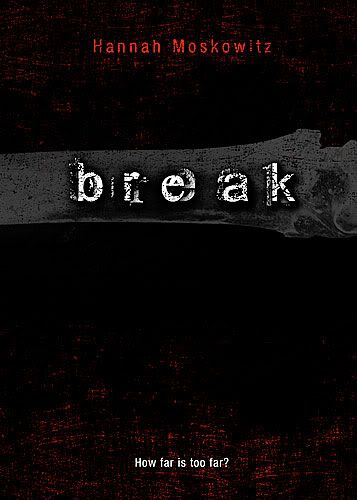
Break by our very own Hannah Moskowitz should be widely available in B&Ns near you! Borders is lagging behind, so go ahead and bother them about it.
You can also buy it on Amazon.
Edit!: For those of you who are interested, the lovely Grace is having a giveaway on her blog, Gracetopia. Win a copy of Break by Hannah Moskowitz, Handcuffs by Bethany Griffin, and Silver Phoenix by Cindy Pon.
Sentences in Bold and Other Quirkz
One of the many quirks I have as a writer manifests itself during edits. Especially when I'm concerned with continuity, I often don't spend too much time angsting over the right words to put in certain places - that comes later. So when I'm faced with a situation that I'm not certain how to handle, I tend to take the easy way out:
Granted, that's a (rather horrible) example I pulled out of my rear just now. But you get the picture, right?
What are some of your writing quirks? Let's see who wins the Weirdest Writer Waward.
I'm also going to share with you another quirk I've discovered. I originally blogged about this on my personal (and dead dyingly dead) blog, which you can read (if you're really bored) by clicking on the link in the sidebar.
Her eyes filled with something that doesn't sound incredibly trite, move on move on let's deal with that later okay cut to DRAMATIC CHASE SCENE OMG
Granted, that's a (rather horrible) example I pulled out of my rear just now. But you get the picture, right?
What are some of your writing quirks? Let's see who wins the Weirdest Writer Waward.
I'm also going to share with you another quirk I've discovered. I originally blogged about this on my personal (and dead dyingly dead) blog, which you can read (if you're really bored) by clicking on the link in the sidebar.
Sometimes, I make lists. I make lists of things that amuse me, lists of things I need to do, lists of things that bother me, lists of things that are ridiculous about my day to day existence, lists of colors of things on my desk, lists of books I want to read, lists of books I haven't read yet, lists of skin care products that people tell me will prevent my eczema from coming back ever ever in a billion years, lists of citrus fruits.
Very rarely does this tendency carry over into writing. However, since I'm sort of stalling on the whole wordcount thing (lol wordcount what is this mysterious creature oh you mean it's supposed to get larger aka grow in magnitude what are you talking about silly internet people), I decided to come up with a different form of motivation.
We're going to call it the "vocabscribble" method. This is what you need (in handy dandy list format!):
- paper
- a pen
- a book, which may be either fiction or nonfiction but must be entertaining or you will want to stab yourself with the aforementioned pen
- your WIP
Now, carefully open the book with your hands. It may be a long time since you've last read a book (*raises hand guiltily*) and so all the books in your house may have a) gotten incredibly dusty or b) began to plot your demise.
After ascertaining whether the book is going to be cooperative, begin to read. Embrace those words with your eyeballs! EMBRACE THEM. Whenever you come across a particularly titillating word, pick up the pen and record it on the piece of paper. Repeat until you have a good list, about 10 to 20 words.
At this point, you may want to have a tea break.
Once you've finished sipping, open your WIP and start writing. Keep a couple of brain cells thinking about the words you've written down. Can you use any in an upcoming sentence? Do any fall into your deathless prose naturally? If so, check off the word and continue writing. When you've checked off all the words, give yourself a reward. A new book, perhaps. Or a cookie.
Note: I don't worry about going in order. My rough drafts don't go in order, and neither do my vocab lists.
Tuesday, August 11, 2009
I'm Bored (and Other Writerly Moods)
Today I was completely and utterly bored. I was at work, and, yeah, I had a lot to do, but I was at my computer all day, and all I could think about was how bored I was. Now all day long, I have my Gmail up, which is the account I use for agent e-mails, and another site, that occasionally I comment on when I need a short break from work. Today, I was completely obsessed with refreshing that site. I just wanted something to happen, and the working wasn't satisfying this craving. (For the record, I did get everything I planned to do at work today done. It really only takes a second to flip to the site, hit F5, and flip back to what I'm working on when it disappoints.)
In my head, all I hear is "I'm bored," "God, something happen," "Why am I soooo bored?"
Then it hit me, just as I was actually about to post "I'm bored" on that website just so something would happen. I wasn't really bored, and I didn't really care what was going on on that site (I mean, I did, but not to that extent). What I secretly wanted to refresh was my Gmail account. But Gmail refreshes itself so frequently that it wouldn't be worth it to refresh that, so my subconscious sent me to the other site to refresh that. Yet it wasn't what I wanted, so even when someone else posted, I was still unsatisfied.
And I wasn't bored. I was frustrated. I want my book to go somewhere. I want to query some more (I'm stuck due to lack of envelopes, stamps, and e-queriable agents), and the WIP's not ready, and I just want the novel I'm querying now to move on to the next stage. I wanted to hear something from someone--to have another little "(1)" at the top of that tab--and I wasn't, and in my mind that static status translated into boredom.
Yawn.
Anyway, it shouldn't have come as such a surprise to me. How often does a full request send my spirits through the roof? Or an important rejection (say on a partial) cause me to snap at my cat for being extra annoying. But this one just seemed strange to me.
So, ever found your emotions completely manipulated by what's going on in the writing world?
In my head, all I hear is "I'm bored," "God, something happen," "Why am I soooo bored?"
Then it hit me, just as I was actually about to post "I'm bored" on that website just so something would happen. I wasn't really bored, and I didn't really care what was going on on that site (I mean, I did, but not to that extent). What I secretly wanted to refresh was my Gmail account. But Gmail refreshes itself so frequently that it wouldn't be worth it to refresh that, so my subconscious sent me to the other site to refresh that. Yet it wasn't what I wanted, so even when someone else posted, I was still unsatisfied.
And I wasn't bored. I was frustrated. I want my book to go somewhere. I want to query some more (I'm stuck due to lack of envelopes, stamps, and e-queriable agents), and the WIP's not ready, and I just want the novel I'm querying now to move on to the next stage. I wanted to hear something from someone--to have another little "(1)" at the top of that tab--and I wasn't, and in my mind that static status translated into boredom.
Yawn.
Anyway, it shouldn't have come as such a surprise to me. How often does a full request send my spirits through the roof? Or an important rejection (say on a partial) cause me to snap at my cat for being extra annoying. But this one just seemed strange to me.
So, ever found your emotions completely manipulated by what's going on in the writing world?
Sunday, August 9, 2009
The 40 Most Exciting Parts
STAGE ONE
1. Getting the EARTH-SHATTERING idea that will SHATTER THE EARTH.
2. Nailing the first scene.
3. Figuring out the climax (an important step in any girl's life).
4. Writing an awesome snippet of dialogue.
5. Finishing the first draft.
STAGE TWO
6. Remember that first scene you nailed? Deleting it. Realizing you didn't need it in the first place.
7. Discovering how to rescue the terrible murky middle from the pits of the earth.
8. Making up a better ending.
9. Saying the same thing in less words.
10. Realizing your book is absolute crap and that you will need to write a new one. Trunking the first one. Starting over from stage 1. Repeating all of stage 2. Again. And again.
11. Ohmigod if I look at this manuscript one more time I just might scream.
STAGE THREE
12. Finding an agent on agentquery who practically begs for your book.
13. Getting a form rejection from her. Your thirst for success deepens.
14. Querying a bunch of agents who sound eh sort of okay maybe they'll like it?
15. Getting your first personalized rejection.
16. Getting your first request.
17. Peeing yourself while you wait.
18. Sending out revenge queries when you are rejected (this is not when you query the same agent again. This is when you query a different agent to show the industry that you will not be tread upon. Most everyone I've ever queried was revenge queried. Shhh don't tell them.)
19. Getting that "Hey I like your book..." email
20. The offer.
21. The phone call.
22. The stars and twinkly lights.
STAGE FOUR
23. Seeing the submission list.
24. Going out on submission.
25. Getting rejections back where editors call you by your last name and talk about you like you're not there. "Though Moskowitz adeptly explores the unicorns in the novel, she neglects to expand on the main premise of the novel. Indeed, I wondered why I was reading a novel about unicorns when I expected one about a boy who wanted to break all his bones." Note: This rejection is not real. BREAK is probably not about unicorns. Probably.)
26. "Hey, so I think an editor might be interested."
27. That editor is interested.
28. Let's talk numbers.
STAGE FIVE
29. Talking to your editor on the phone.
30. Getting a MASSIVE BOX OF BOOKS from her. (Was this just me? Well it rocked.)
31. Seeing the cover.
32. Seeing the cover.
33. Seeing the cover.
34. Chopping out random lines of witty dialogue someone doesn't like. Realizing how unnecessary they were.
35. Wondering how the hell this paragraph got into your manuscript.
36. Changing 7-11 to 7-Eleven because your copyeditor tells you to.
37. Seeing what customers who pre-ordered your book on Amazon also ordered.
38. The first review.
39. Realizing your book comes out in 16 days.
40. Seeing that bitch on a bookshelf. I assume.
1. Getting the EARTH-SHATTERING idea that will SHATTER THE EARTH.
2. Nailing the first scene.
3. Figuring out the climax (an important step in any girl's life).
4. Writing an awesome snippet of dialogue.
5. Finishing the first draft.
STAGE TWO
6. Remember that first scene you nailed? Deleting it. Realizing you didn't need it in the first place.
7. Discovering how to rescue the terrible murky middle from the pits of the earth.
8. Making up a better ending.
9. Saying the same thing in less words.
10. Realizing your book is absolute crap and that you will need to write a new one. Trunking the first one. Starting over from stage 1. Repeating all of stage 2. Again. And again.
11. Ohmigod if I look at this manuscript one more time I just might scream.
STAGE THREE
12. Finding an agent on agentquery who practically begs for your book.
13. Getting a form rejection from her. Your thirst for success deepens.
14. Querying a bunch of agents who sound eh sort of okay maybe they'll like it?
15. Getting your first personalized rejection.
16. Getting your first request.
17. Peeing yourself while you wait.
18. Sending out revenge queries when you are rejected (this is not when you query the same agent again. This is when you query a different agent to show the industry that you will not be tread upon. Most everyone I've ever queried was revenge queried. Shhh don't tell them.)
19. Getting that "Hey I like your book..." email
20. The offer.
21. The phone call.
22. The stars and twinkly lights.
STAGE FOUR
23. Seeing the submission list.
24. Going out on submission.
25. Getting rejections back where editors call you by your last name and talk about you like you're not there. "Though Moskowitz adeptly explores the unicorns in the novel, she neglects to expand on the main premise of the novel. Indeed, I wondered why I was reading a novel about unicorns when I expected one about a boy who wanted to break all his bones." Note: This rejection is not real. BREAK is probably not about unicorns. Probably.)
26. "Hey, so I think an editor might be interested."
27. That editor is interested.
28. Let's talk numbers.
STAGE FIVE
29. Talking to your editor on the phone.
30. Getting a MASSIVE BOX OF BOOKS from her. (Was this just me? Well it rocked.)
31. Seeing the cover.
32. Seeing the cover.
33. Seeing the cover.
34. Chopping out random lines of witty dialogue someone doesn't like. Realizing how unnecessary they were.
35. Wondering how the hell this paragraph got into your manuscript.
36. Changing 7-11 to 7-Eleven because your copyeditor tells you to.
37. Seeing what customers who pre-ordered your book on Amazon also ordered.
38. The first review.
39. Realizing your book comes out in 16 days.
40. Seeing that bitch on a bookshelf. I assume.
Thursday, August 6, 2009
A Double-Take
I'm currently in Montréal for Worldcon, and I happened to sit in on a panel about taboos in writing, just because, you know, it was there and we've discussed edgy fic a lot on this blog. Anyway, as I'm sitting there, a woman in the audience asked about the prevalence of YA lit in the SFF market, and the panelists could not name any GLBTQ YA fiction.
I was floored. ON THE FLOOR I WAS FLOORED.
Clearly this situation has to be remedied.
Now this is what you should do, YAYAers: Go out into the world and tell everyone how progressive and nifty YA fiction is. Tell them how we hit those taboos and we hit them hard. Tell them how moving, exciting, literary and deathless the prose of your favorite YA writer is. Tell everyone you can, because YA isn't getting the recognition it deserves!
I was floored. ON THE FLOOR I WAS FLOORED.
Clearly this situation has to be remedied.
Now this is what you should do, YAYAers: Go out into the world and tell everyone how progressive and nifty YA fiction is. Tell them how we hit those taboos and we hit them hard. Tell them how moving, exciting, literary and deathless the prose of your favorite YA writer is. Tell everyone you can, because YA isn't getting the recognition it deserves!
Saturday, July 25, 2009
You Know What I Mean
If you are reading this blog, chances are you've been there. It's the darkest time in that hellacious novel-writing process, the one that makes death by fire seem like a balmy day on the Florida Keys in comparison. It stinks. It sucks. It resembles death of an emotional sort except that death would mean that the suffering would end.
I'm talking about round one of revisions.
Let's break it down in nifty list format:
1. Sophie is contented with her life and her future prospects.
2. Sophie decides it's time to write another book.
3. Sophie takes out her super artistical tools of the trade (Microsoft Word)
4. Sophie composes a brilliant novel filled with breathtaking characters and deathless prose.
5. Sophie retires, leaving the novel to its own devices for a week or so, in order to rest her genius mind.
Now things get ugly:
6. Novel gets evil glint in its eye.
7. Novel conspires with its sociopathic friends Computer and Word to delete the genius and add the dreck.
8. Novel cackles manically.
9. Sophie opens Word after one week, prepared to make two or three edits to her amazing novel.
10. Sophie reads first sentence.
11. Sophie sobs.
12. Sophie runs to the fridge and opens up a new gallon of Rocky Road.
I'm currently in the middle of a massive rewrite and overhaul of this novel. I explained my pain best to my fellow YAYAs: "Editing ST is like sleeping with that really hot guy who's also a total dickwad. It feels so good when it's happening and you think you're in love but when it's over all you have left is shame."
I'm talking about round one of revisions.
Let's break it down in nifty list format:
1. Sophie is contented with her life and her future prospects.
2. Sophie decides it's time to write another book.
3. Sophie takes out her super artistical tools of the trade (Microsoft Word)
4. Sophie composes a brilliant novel filled with breathtaking characters and deathless prose.
5. Sophie retires, leaving the novel to its own devices for a week or so, in order to rest her genius mind.
Now things get ugly:
6. Novel gets evil glint in its eye.
7. Novel conspires with its sociopathic friends Computer and Word to delete the genius and add the dreck.
8. Novel cackles manically.
9. Sophie opens Word after one week, prepared to make two or three edits to her amazing novel.
10. Sophie reads first sentence.
11. Sophie sobs.
12. Sophie runs to the fridge and opens up a new gallon of Rocky Road.
I'm currently in the middle of a massive rewrite and overhaul of this novel. I explained my pain best to my fellow YAYAs: "Editing ST is like sleeping with that really hot guy who's also a total dickwad. It feels so good when it's happening and you think you're in love but when it's over all you have left is shame."
Friday, July 24, 2009
Contest on Hannah's Blog

Hannah Moskowitz, YAYA contributor and author extraordinaire, is holding a contest on her blog.
In a few hours, it will officially be 1 month until BREAK.
I can't believe this is happening.
In honor of this momentous occasion, I want to hear any funny injury stories you have. Bonus if it involves a broken bone, but it's fine if not--I've never broken any bones myself, so I'm sympathetic if you don't have a story to share...
Give me your stories, I'll choose my favorite and the winner gets to name a character in the next chapter of ATWF. Male or female, doesn't matter. I need some names!
Click here to enter! And don't forget to look for Break, from Simon Pulse, available on August 25th.
Thursday, July 23, 2009
Do the Genre Hop! (Hop Hop Hop!)
Or, you know, don’t.
Fans of authors expect a certain voice or genre from an author after buying their first book. After all, say Meg Cabot (wonderful lady and author that she is) wrote a horror-erotica, violent Victorian-era YA novel. Her fans would be shocked, because that’s not something they expect from the author.
So it comes down to this: How much does the author owe the reader, and the market? If a voice is chatty and cutesy in the first novel, set in a high school, can the author “genre-hop” with their second novel (say a murder mystery set in medieval times?) Well, no. Not quite.
Often publishing contracts will include a clause stating that the publisher has the first look at the author’s next work. Maybe it’s only the author’s next work in said genre. There are even situations where, unfortunately, the author must have their next work be in the same genre regardless of their future plans for writing.
I’m going to make up a pseudonym here. Say Wright Author only planned on writing one young adult fantasy book their whole lives, and the manuscript got them a literary agent. Awesome, right? However, if their voice and genre aren’t consistent, their marketability down the road plummets. Authors are creating a name or “brand,” and readers expect something from that brand. Authors may well be forced to churn out another young adult fantasy book to fulfill the clause. Wright Author is stuck without a home for their loveably witty adult mystery.
I’m not saying this is how the world works—no, of course not, there are always exceptions and there are always restrictions. However, as a reader, would it bug you if your favorite author wrote something in a genre you don’t normally read? Would you “follow” the author over into another genre, or would you pass in favor of a new favorite author in the same genre you love?
Fans of authors expect a certain voice or genre from an author after buying their first book. After all, say Meg Cabot (wonderful lady and author that she is) wrote a horror-erotica, violent Victorian-era YA novel. Her fans would be shocked, because that’s not something they expect from the author.
So it comes down to this: How much does the author owe the reader, and the market? If a voice is chatty and cutesy in the first novel, set in a high school, can the author “genre-hop” with their second novel (say a murder mystery set in medieval times?) Well, no. Not quite.
Often publishing contracts will include a clause stating that the publisher has the first look at the author’s next work. Maybe it’s only the author’s next work in said genre. There are even situations where, unfortunately, the author must have their next work be in the same genre regardless of their future plans for writing.
I’m going to make up a pseudonym here. Say Wright Author only planned on writing one young adult fantasy book their whole lives, and the manuscript got them a literary agent. Awesome, right? However, if their voice and genre aren’t consistent, their marketability down the road plummets. Authors are creating a name or “brand,” and readers expect something from that brand. Authors may well be forced to churn out another young adult fantasy book to fulfill the clause. Wright Author is stuck without a home for their loveably witty adult mystery.
I’m not saying this is how the world works—no, of course not, there are always exceptions and there are always restrictions. However, as a reader, would it bug you if your favorite author wrote something in a genre you don’t normally read? Would you “follow” the author over into another genre, or would you pass in favor of a new favorite author in the same genre you love?
Saturday, July 18, 2009
First Sentences Revealed
It's been a bit more than a week, but here's the list of books to match the first sentences I posted!
1. The day begins in the middle of the night.
Nick & Norah's Infinite Playlist by Rachel Cohn and David Levithan
6. After midnight, the apartment waited, still in the moonlight and the heat.
The Spellbook of Listen Taylor by Jaclyn Moriarty
If you liked any of these first sentences, maybe you should go and check out the book, too!
1. The day begins in the middle of the night.
Nick & Norah's Infinite Playlist by Rachel Cohn and David Levithan
2. Marly was dead, to begin with.
Marly's Ghost by David Levithan
Marly's Ghost by David Levithan
3. It wasn't supposed to be this hot and humid on Cape Cod.
The Secret Circle: The Initiation by L.J. Smith
The Secret Circle: The Initiation by L.J. Smith
4. "Sex and religion don't mix," my grandma once told me.
The God Box by Alex Sanchez
The God Box by Alex Sanchez
5. Even the woods are burning.
Here Lies Arthur by Philip Reeve
Here Lies Arthur by Philip Reeve
The Spellbook of Listen Taylor by Jaclyn Moriarty
If you liked any of these first sentences, maybe you should go and check out the book, too!
Friday, July 10, 2009
Interview: Eileen Cook
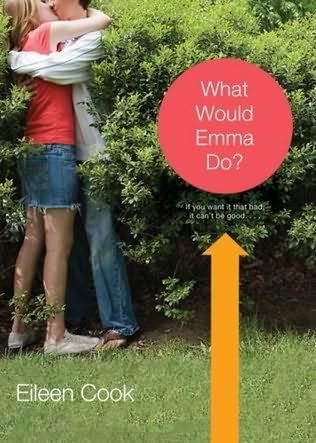
Eileen Cook's WHAT WOULD EMMA DO? is her first YA novel, but we hope to see more of her writing in this genre. WHAT WOULD EMMA DO? chronicles (isn't that a fun verb?) the coming of age of the titular Emma as she grows up in her small, religious town. Eileen was willing to do an interview with YAYA and, as you can see, she had a lot of fun answering our questions.
YAYA: How did you start writing?
Eileen Cook: Both of my parents are big readers. Weekly trips to the library were a part of our family routine and we’d come home with stacks of books. I’ve loved books and reading as long as I can remember. As soon as I understood that there people who got to make those stories up I knew that I wanted to do that. My parents saved an English homework assignment I did in second grade where the teacher wrote at the bottom “Someday I’m sure you will be an author!” When my first book came out my dad hunted down this teacher. She was over 90 years old and lived in a nursing home. We went out to visit her and my parents were hoping for a big meaningful moment- but she spent the whole time talking about her bunions.
Do you have any advice for aspiring authors?
1) Read- read a lot. You can learn so much about writing this way. Read books you like and books you hate. Break them down to see what works and what doesn’t. Underline or highlight passages/dialog you really like (assuming that this isn’t a library book). It isn’t about trying to write like someone else, it is about discovering the process of what makes a story work.
2) Keep Writing: A lot of people talk about writing, but don’t do it. With every thing you write you get a bit better, you learn a bit more. If you give up then you won’t be published. If you keep trying- then who knows?
3) Seize the day: You won’t have anything to write about if you never leave the house. Try new things, meet new people, travel, you never know what will lead you to the next story.
What’s your writing schedule like?
People have a schedule? I really should get one of those.
I love the idea of having a set routine or process, but I find my life keeps getting in the way. Sometimes I write at home and other times I like to be in a coffee shop or at the library. I write in the morning, afternoon, or evening- depending on when I have the time. I still work another job part time so writing has to fit in with everything else. The only consistent would be that when I am in the middle of the story I find I need to write at least a small bit every day or I lose track of the story.
You tackle some pretty big issues in your novel -- especially religion. Did you experience any feelings of trepidation?
Here is a wishy washy answer for you, yes and no. I know that some of the topics I covered are very important to people and I didn't want to offend anyone. However, when I'm reading the books I like are those that have something to say on big issues. I don't mind if people disagree with me, but I think it is important that we have the discussion. If we don't how will we ever see different points of view?
Some of my favorite books are banned so if WWED is ever on the list at least I'll be in great company!
Have you spent a lot of time in a small town?
I grew up in a small town in Michigan called Traverse City. It isn't that small anymore! It's grown a lot.
Do you have thoughts on the growth and evolution of YA as a genre?
I am HUGELY impressed at what is now available in YA. While there were some great books when I was a teen, there were also a lot of books that clearly had "a lesson." You would be reading along and suddenly it would be all "...and that is why young reader it is important to always think of the golden rule." It used to drive me nuts. I started reading more adult fiction because I wanted books that didn't always have a nice tidy outcome. YA books now reflect that teens are aware and facing a range of situations. There don't appear to be any topics that are taboo. It lets the reader decide what they want to pick up.
I want to ask our readers: What questions do you have for future interviews? Any authors you'd like to see? Email us! Our address is on the right-hand side of the page.
YAYA: How did you start writing?
Eileen Cook: Both of my parents are big readers. Weekly trips to the library were a part of our family routine and we’d come home with stacks of books. I’ve loved books and reading as long as I can remember. As soon as I understood that there people who got to make those stories up I knew that I wanted to do that. My parents saved an English homework assignment I did in second grade where the teacher wrote at the bottom “Someday I’m sure you will be an author!” When my first book came out my dad hunted down this teacher. She was over 90 years old and lived in a nursing home. We went out to visit her and my parents were hoping for a big meaningful moment- but she spent the whole time talking about her bunions.
Do you have any advice for aspiring authors?
1) Read- read a lot. You can learn so much about writing this way. Read books you like and books you hate. Break them down to see what works and what doesn’t. Underline or highlight passages/dialog you really like (assuming that this isn’t a library book). It isn’t about trying to write like someone else, it is about discovering the process of what makes a story work.
2) Keep Writing: A lot of people talk about writing, but don’t do it. With every thing you write you get a bit better, you learn a bit more. If you give up then you won’t be published. If you keep trying- then who knows?
3) Seize the day: You won’t have anything to write about if you never leave the house. Try new things, meet new people, travel, you never know what will lead you to the next story.
What’s your writing schedule like?
People have a schedule? I really should get one of those.
I love the idea of having a set routine or process, but I find my life keeps getting in the way. Sometimes I write at home and other times I like to be in a coffee shop or at the library. I write in the morning, afternoon, or evening- depending on when I have the time. I still work another job part time so writing has to fit in with everything else. The only consistent would be that when I am in the middle of the story I find I need to write at least a small bit every day or I lose track of the story.
You tackle some pretty big issues in your novel -- especially religion. Did you experience any feelings of trepidation?
Here is a wishy washy answer for you, yes and no. I know that some of the topics I covered are very important to people and I didn't want to offend anyone. However, when I'm reading the books I like are those that have something to say on big issues. I don't mind if people disagree with me, but I think it is important that we have the discussion. If we don't how will we ever see different points of view?
Some of my favorite books are banned so if WWED is ever on the list at least I'll be in great company!
Have you spent a lot of time in a small town?
I grew up in a small town in Michigan called Traverse City. It isn't that small anymore! It's grown a lot.
Do you have thoughts on the growth and evolution of YA as a genre?
I am HUGELY impressed at what is now available in YA. While there were some great books when I was a teen, there were also a lot of books that clearly had "a lesson." You would be reading along and suddenly it would be all "...and that is why young reader it is important to always think of the golden rule." It used to drive me nuts. I started reading more adult fiction because I wanted books that didn't always have a nice tidy outcome. YA books now reflect that teens are aware and facing a range of situations. There don't appear to be any topics that are taboo. It lets the reader decide what they want to pick up.
I want to ask our readers: What questions do you have for future interviews? Any authors you'd like to see? Email us! Our address is on the right-hand side of the page.
Monday, July 6, 2009
Firsts
Agents, editors, and the like frequently write/speak/blog about the importance of 'firsts' in novels: the first chapter, the first five pages, the first page, the first paragraph, the first sentence.
But how important are these things to actual readers?
Of course the first chapter would be important, since a boring first chapter would get you nowhere. And the first five pages should probably include something more than aimless dialogue or incessant exposition and back-story. But what about the first page? Or the first paragraph? Or, especially, the first sentence?
Usually, in my experience, by the time a reader opens a book to read the first page or two, they know at least a bit about the novel either from a friend, a magazine/newspaper article, a poster, the back of the book, or whatever. While the reader might put the book down if it just isn't for them, I question whether a first sentence, paragraph, or page will sway someone one way or another given what they already know about the book.
So I wanted to ask YAYA readers and contributors: Do you ever put a book down after reading the first sentence? The first paragraph? The first page?
I definitely understand putting a book down when the actual writing style doesn't mesh with your personal likes, but that would be true regardless of what the author put in that first page. Does the actual content ever sway your decision?
I took a look at the limited number of young adult books I have on my desk next to me and decided to write down some first sentences. Would you keep reading?
1. The day begins in the middle of the night.
But how important are these things to actual readers?
Of course the first chapter would be important, since a boring first chapter would get you nowhere. And the first five pages should probably include something more than aimless dialogue or incessant exposition and back-story. But what about the first page? Or the first paragraph? Or, especially, the first sentence?
Usually, in my experience, by the time a reader opens a book to read the first page or two, they know at least a bit about the novel either from a friend, a magazine/newspaper article, a poster, the back of the book, or whatever. While the reader might put the book down if it just isn't for them, I question whether a first sentence, paragraph, or page will sway someone one way or another given what they already know about the book.
So I wanted to ask YAYA readers and contributors: Do you ever put a book down after reading the first sentence? The first paragraph? The first page?
I definitely understand putting a book down when the actual writing style doesn't mesh with your personal likes, but that would be true regardless of what the author put in that first page. Does the actual content ever sway your decision?
I took a look at the limited number of young adult books I have on my desk next to me and decided to write down some first sentences. Would you keep reading?
1. The day begins in the middle of the night.
2. Marly was dead, to begin with.
3. It wasn't supposed to be this hot and humid on Cape Cod.
4. "Sex and religion don't mix," my grandma once told me.
5. Even the woods are burning.
6. After midnight, the apartment waited, still in the moonlight and the heat.
Which of these sentences make you want to keep reading? Any of them? All of them? None of them?
Can you identify any of the books these came from? (Answers will come next week. I'll be surprised if anyone gets these(without using Google!), as the books are an eclectic mix spanning the last several years.)
One last question: Do you have any favorite first lines?
Which of these sentences make you want to keep reading? Any of them? All of them? None of them?
Can you identify any of the books these came from? (Answers will come next week. I'll be surprised if anyone gets these(without using Google!), as the books are an eclectic mix spanning the last several years.)
One last question: Do you have any favorite first lines?
Sunday, June 28, 2009
Young Adult Genre Revival
This will be a relatively short YAYA posting, but I wanted to get everyone, readers and bloggers alike, involved, so make sure to offer your opinions!
Lately, literary agents have been looking for steampunk and dystopian novels, implying that these may become 'the next big thing' so to speak (no guarantees!).
So here's the question: Is there something you'd like to see in young adult novels, something that was prominent in the lengthy history of world literature, that isn't there now? Some genre, or topic, that you just love, but isn't present in today's young adult lit just yet?
For example, maybe you have a secret love of biji (筆記), a genre from Classical Chinese literature that was like a notebook, with short stories, anecdotes, quotations, etc. from the author (Biji). There are a few books like this in young adult right now, like CATHY'S BOOK by Sean Stewart and Jordan Weisman (Amazon), but maybe you'd like to see more. (Note: Cathy's Book is also an interactive mystery, so slightly different, but very similar in principal.)
Or maybe you reread Homer's THE ODYSSEY (Amazon) every single year and would like to see more young adult that has a large body of water as its main setting. I'm not sure of any current young adult like this, so leave a comment with an example if you know one.
Perhaps you're just looking for a new type of fiction all together such as the slice of life, or tranche de vie, where there is minimal plot, little character development, and an open ending. Something more true to life than any other kind of fiction. The YAYA bloggers discussed a desire to see more of this just the other day. This, of course, would be a more difficult endeavor because keeping someone interested with the daily happenings of life is difficult, but it has been done. Non-YA examples include James Joyce's DUBLINERS (Amazon) and John Steinbeck's OF MICE AND MEN (Amazon).
So let me ask again, in case you become distracted with filling your Amazon shopping cart...
What genre, topic, or literature form would you like to see more of in modern young adult literature?
Lately, literary agents have been looking for steampunk and dystopian novels, implying that these may become 'the next big thing' so to speak (no guarantees!).
So here's the question: Is there something you'd like to see in young adult novels, something that was prominent in the lengthy history of world literature, that isn't there now? Some genre, or topic, that you just love, but isn't present in today's young adult lit just yet?
For example, maybe you have a secret love of biji (筆記), a genre from Classical Chinese literature that was like a notebook, with short stories, anecdotes, quotations, etc. from the author (Biji). There are a few books like this in young adult right now, like CATHY'S BOOK by Sean Stewart and Jordan Weisman (Amazon), but maybe you'd like to see more. (Note: Cathy's Book is also an interactive mystery, so slightly different, but very similar in principal.)
Or maybe you reread Homer's THE ODYSSEY (Amazon) every single year and would like to see more young adult that has a large body of water as its main setting. I'm not sure of any current young adult like this, so leave a comment with an example if you know one.
Perhaps you're just looking for a new type of fiction all together such as the slice of life, or tranche de vie, where there is minimal plot, little character development, and an open ending. Something more true to life than any other kind of fiction. The YAYA bloggers discussed a desire to see more of this just the other day. This, of course, would be a more difficult endeavor because keeping someone interested with the daily happenings of life is difficult, but it has been done. Non-YA examples include James Joyce's DUBLINERS (Amazon) and John Steinbeck's OF MICE AND MEN (Amazon).
So let me ask again, in case you become distracted with filling your Amazon shopping cart...
What genre, topic, or literature form would you like to see more of in modern young adult literature?
Sunday, June 21, 2009
Interview: Laurie Halse Anderson
Summer reading means a lot of things to us at YAYA, mostly because it's one of the few seasons when we can read for extended periods of time. One book we always, always recommend to aspiring YA writers is Laurie Halse Anderson's Speak. Laurie graciously agreed to do an interview as part of our Summer Author Spotlight.
In addition to Speak, Laurie has written five other YA novels: Twisted, Prom, Chains, Catalyst, and her newest novel, Wintergirls. She's won more awards than I care to count (mostly because it'll make me feel inferior - I'm fragile like that) and is an all-around very cool lady.

YAYA: How did you start writing?
Laurie Halse Anderson: I started writing for fun in second grade. I was a journalist in my twenties. I didn't try to be a published author until my early thirties.
From where have you drawn inspiration?
My Readers.
Speak seems to be a novel that we're always recommending to aspiring YA authors. Can you talk about the difference between writing a first book and a second, in terms of the expectations of a growing audience?
I found the expectations daunting. It took me awhile to figure out how to write without worrying about what other people would think.
Do you have any favorite scenes in your novels?
No
What was your day job before becoming a literary rockstar?
I don't know, I'm not there yet. (Modesty!) Before SPEAK was published, I was a mom and freelance journalist. (I'm still a mom!)
Have you written novels for other age groups?
Yes, historical novels aimed at middle grades; a series of animal adventure books for older elementary kids and picture books for little kids.
If so, what makes YA different?
Level of emotional intensity and more mature themes.
Do you have thoughts on the growth and evolution of YA as a genre?
I think it is wonderful because teenagers need good books to read. (Yes!!)
Do you believe that Speak and Wintergirls have the potential to become "crossover" novels?
Based on my mail, they already are. I am honored by that fact.
Do you have a favorite author?
Neil Gaiman
Do you have a favorite cliché?
I avoid cliches like the plague!
What's your writing schedule like?
Write from 7AM-3PM, go for a run, do writing business the rest of day. On a deadline, write for 18 hours a day.
In addition to Speak, Laurie has written five other YA novels: Twisted, Prom, Chains, Catalyst, and her newest novel, Wintergirls. She's won more awards than I care to count (mostly because it'll make me feel inferior - I'm fragile like that) and is an all-around very cool lady.
YAYA: How did you start writing?
Laurie Halse Anderson: I started writing for fun in second grade. I was a journalist in my twenties. I didn't try to be a published author until my early thirties.
From where have you drawn inspiration?
My Readers.
Speak seems to be a novel that we're always recommending to aspiring YA authors. Can you talk about the difference between writing a first book and a second, in terms of the expectations of a growing audience?
I found the expectations daunting. It took me awhile to figure out how to write without worrying about what other people would think.
Do you have any favorite scenes in your novels?
No
What was your day job before becoming a literary rockstar?
I don't know, I'm not there yet. (Modesty!) Before SPEAK was published, I was a mom and freelance journalist. (I'm still a mom!)
Have you written novels for other age groups?
Yes, historical novels aimed at middle grades; a series of animal adventure books for older elementary kids and picture books for little kids.
If so, what makes YA different?
Level of emotional intensity and more mature themes.
Do you have thoughts on the growth and evolution of YA as a genre?
I think it is wonderful because teenagers need good books to read. (Yes!!)
Do you believe that Speak and Wintergirls have the potential to become "crossover" novels?
Based on my mail, they already are. I am honored by that fact.
Do you have a favorite author?
Neil Gaiman
Do you have a favorite cliché?
I avoid cliches like the plague!
What's your writing schedule like?
Write from 7AM-3PM, go for a run, do writing business the rest of day. On a deadline, write for 18 hours a day.
Subscribe to:
Posts (Atom)

 Name: Andrew Carmichael
 Name: Vanessa Concannon
 Name: Trish Doller
 Name: Bethany Griffin
 Name: Amanda K. Morgan
 Name: Hannah Moskowitz Esq. (I have no idea what esq. means, but I like it.)
 Name: Sage
 Name: Sasha Vivelo
 Name: Sophie Wereley
 Name: Suzanne Young